Meditation in Motion: How Standing Still Changed My Pace of Living

The Body Learns Before the Mind
For a long time, I thought slowing down was a decision. I assumed that if I understood the concept of calmness, if I agreed with it intellectually, I would naturally become slower.
But it never worked that way.
I could read about mindfulness in the morning and still rush through my day by noon. I could understand the importance of rest and still feel a frantic restlessness while trying to “relax.” Understanding changed nothing. My mind was convinced, but my nervous system was still running a race I hadn’t signed up for.
We Live Above the Neck
Most of my life happens in my head. Planning, replaying conversations, imagining outcomes. Even when I tell myself I want to “slow down,” the desire itself feels urgent, almost aggressive.
I once realised something quietly unsettling: my thoughts move faster than my body ever could. We live “above the neck”, treating our bodies like vehicles to carry our brains from one meeting to the next.
When I try to slow down using only my mind, it’s like trying to stop a speeding train by shouting at the conductor. It doesn’t work. To change the speed, I have to touch the machinery.
The First Shift Happened in My Legs
The first real change didn’t happen through a profound insight. It happened in discomfort. It happened during Zhan Zhuang—standing meditation.
The posture looks deceptively simple: arms rounded as if hugging a tree, knees slightly bent, eyes soft. But within minutes, my mind begins searching for an exit. How long has it been? Is this enough? What’s next on the to-do list?
My body does not respond to these questions. It simply continues standing.
Then, the shift occurs. The trembling in my thighs becomes warmth. The warmth becomes weight. The weight becomes a sense of being anchored. For the first time, my attention is pulled down from the clouds of my thoughts and into the soles of my feet. The shift begins there—not in a “zen” thought, but in the reality of muscle and bone.
My Breath Changed Before My Thoughts Did
I’ve learned that I cannot “think slower.” My brain is built for speed. But I can breathe slower.
When I stay in the stillness long enough, sometimes with the minimalist piano of Ludovico Einaudi in the background, sometimes in total silence. My breathing eventually settles. It isn’t forced; it simply finds its natural floor.
When my breath slows, my heartbeat follows. When my heartbeat softens, my thoughts lose their sharp edges. They don’t stop, but they stop being so loud. I’ve realised that I don’t need to control my mind; I just need to give my body a reason to be still.
No stretching. No flowing sequence. No performance. Just standing.
A Few Resources I Keep Returning To
1. A Gentle Introduction to Zhan Zhuang
This is a masterclass in the art of doing nothing. It’s a practice of standing still until you realise that you aren’t just standing; you are being held by the earth.
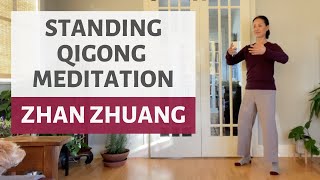
STANDING QIGONG MEDITATION | ZHAN ZHUANG
QiYoga With LuChin
Watch on YouTube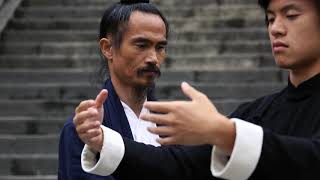
Yuan Xiu Gang: Learning Zhan Zhuang - Wudang Healing Arts
Wudang Academy
Watch on YouTube
Why Just STANDING Might be the Most Profound Exercise - Zhan Zhuang
The Bioneer
Watch on YouTube2. Finding the Rhythm in Sound
Sometimes silence is too heavy. I use some minimalist tracks or white-noise music as a “metronome” for my breath. They help synchronise my heart rate with the space around me, especially when I stay home.
The Sunday Practice
If you find yourself “rushing to relax” this week, try this: Don’t try to clear your mind. Instead, just stand.
Stand in your kitchen while the kettle boils. Stand in your room for five minutes before you open your laptop. Don’t worry about your thoughts. Just notice the weight of your body in your heels. Then notice your breath.
Let your body teach your mind how to be still. It’s a slower way to learn, but it’s the only one that sticks.
I tried, and it worked. The key is that you allow your body to be still.